Executive learning promise
After this lesson, you should be able to identify when a prospecting activity crosses the line from permitted business development into a prohibited sales practice, choose the compliant next step, and reject answer choices that reward pressure, omission, misleading communication, or rule avoidance.
What you will learn
- Distinguish permitted prospecting from prohibited sales practices under the Series 7 business-seeking function.
- Recognize misleading, exaggerated, promissory, or incomplete statements in customer communications.
- Apply solicitation, telemarketing, electronic communication, and social media guardrails to exam-style scenarios.
- Choose the most appropriate supervisory, documentation, or escalation response when a prospecting issue appears.
- Separate firm-approved communication from unapproved personal-channel activity.
Blueprint mapping
Domain: Seeks Business for the Broker-Dealer from Customers and Potential Customers.
Subskills: contacts current and potential customers; describes investment products and services; distributes retail communications; uses electronic and social media communications; complies with telemarketing and solicitation rules; identifies prohibited sales practices.
Blueprint weight: 7% for this function in the supplied outline.
Why it matters
- Prospecting questions often test conduct before an account is opened; the candidate must recognize that investor protection duties start with the first contact, not only after the customer buys a security.
- Exam answer choices commonly hide violations inside attractive business goals: winning a large account, responding quickly, using social media, or simplifying a complex product.
- The key conflict is usually not whether the product could be suitable later; it is whether the representative used a truthful, fair, supervised, and rule-compliant method to seek business.
- When a stem includes pressure tactics, performance guarantees, unapproved communications, or avoidance of required disclosures, the safest exam answer usually involves stopping, correcting, disclosing, escalating, or obtaining approval.
Key Terms & Must-Know Facts
1.1.1.1 Exam relevance
This topic appears as short scenario questions in which a registered representative wants to contact prospects, distribute communications, discuss product benefits, or use electronic media. Candidates often confuse aggressive but legal sales effort with prohibited conduct. The Series 7 exam tests whether you can identify the single disqualifying clue: a guarantee, omission, unapproved channel, misleading comparison, improper timing, or failure to respect solicitation restrictions.
- Prospecting
- Business-seeking activity directed at potential or current customers, including calls, electronic messages, seminars, referrals, and product discussions.
- Prohibited sales practice
- A method of seeking business or recommending activity that violates fairness, disclosure, supervision, communication, or customer-protection standards.
- Retail communication
- A communication distributed or made available to retail investors that must be fair, balanced, and not misleading.
- Correspondence
- Written or electronic communication directed to a small number of retail investors, still subject to firm supervision and content standards.
- Institutional communication
- Communication directed only to institutional investors; it may have different review requirements but still cannot be misleading.
- Misrepresentation
- An untrue or misleading statement about a product, risk, return, firm, representative, or service.
- Omission
- Leaving out a material fact so that the communication creates a misleading impression.
- Guarantee
- A promise of a particular investment result where no permitted guarantee exists; this is a classic prohibited-practice clue.
- Telemarketing and solicitation rules
- Rules that restrict how and when prospects may be contacted and require firms and representatives to respect applicable do-not-call and solicitation limitations.
- Social media communication
- Electronic communication that may be public, semi-public, static, interactive, or direct; use must remain supervised and compliant with firm procedures.
- Outside or unapproved channel
- A personal account, messaging app, or platform not approved or retained by the firm for business communications.
- Supervisory approval
- Required firm review or permission before certain communications, account activities, or solicitation methods may be used.
1.1.1.2 Must-know facts
- Fairness and accuracy apply even before the person becomes a customer.
- A true statement can still be misleading if key risk, cost, liquidity, or limitation information is omitted.
- Performance examples require context; cherry-picked returns and unsupported claims are red flags.
- Personal social media or messaging tools are not automatically acceptable for business just because the content is brief.
- Calling restrictions are tested through timing, do-not-call status, prior relationship, consent, and firm procedures.
- Do not fix a flawed communication by adding enthusiasm; fix it by adding balance, disclosure, review, or by withdrawing it.
- When the issue is supervision, the best answer is usually to obtain approval or follow firm procedures before use, not after distribution.
Core content
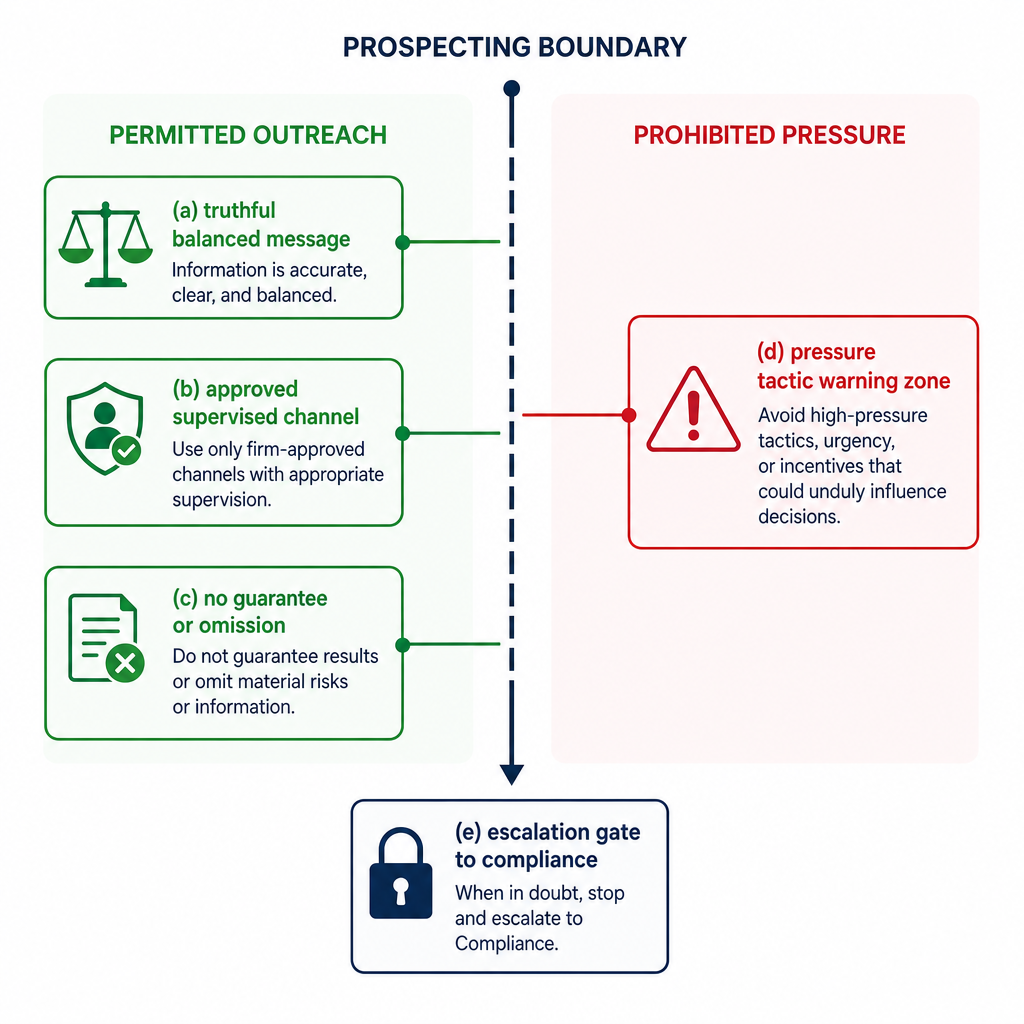
1.1.1.3 1. The prospecting boundary: permitted outreach vs prohibited pressure
A Explanation
Decision conflict: choose active business development when it is truthful, supervised, and respectful of customer protections; reject business development when the representative uses pressure, deception, or rule evasion. On the exam, the fact that a prospect has not yet opened an account does not relax the standard. The representative is still acting on behalf of the broker-dealer and must comply with communication and solicitation rules.
WHY THIS IS TESTED: Series 7 candidates frequently think account-opening duties begin only after paperwork is signed. FINRA-style scenarios often test an earlier point: the first call, seminar invitation, product email, or social media post. The best answer identifies whether the outreach method itself is permissible.
Exam takeaway: Separate compliant outreach from prohibited pressure by checking message, method, and supervision before focusing on the sale.
B Worked example
An analyst at an RIA is asked by their compliance officer to review a broker-dealer representative's plan to invite retirees to a lunch seminar. Market volatility has increased, the firm wants new assets, and the invitation says, "Protect your retirement income with investments designed to avoid market losses." The seminar will discuss securities products that carry credit, liquidity, and market risks. The distracting clue is that the lunch is educational and no account application will be completed onsite. The tempting-but-wrong clue is that retirees are only being invited to learn, not buy.
Reasoning chain: The task is to determine whether the prospecting communication is acceptable. The key facts are the broad retail audience, the reference to avoiding market losses, and the omission of product risks. The rule is that prospecting communication must be fair, balanced, and not misleading. The educational setting does not cure an exaggerated or promissory message. The most appropriate next step is to revise the invitation so it does not imply loss avoidance and includes balanced risk context, with any required firm approval before distribution.
C Checkpoint MCQ
A registered representative wants to email prospects an invitation stating that a new income strategy is "a safe way to protect principal while receiving attractive returns." The product involves securities with market and liquidity risk. What is the most appropriate next step?
- Send the email because it is only an invitation, not a recommendation.
- Send the email only to prospects who are close to retirement.
- Revise the email to remove misleading safety language and include balanced risk context before any required approval.
- Send the email from a personal account so the tone feels less formal.
Answer: C. A is tempting because no sale has occurred, but invitations are still communications. B is tempting because the audience seems relevant, but audience relevance does not cure misleading content. C is correct because the statement implies safety and principal protection despite securities risk. D is wrong because personal channels create supervision and retention concerns.
1.1.1.4 2. Misleading communications: guarantees, omissions, and cherry-picked claims
A Explanation
Decision conflict: choose accurate, balanced product descriptions; reject statements that create certainty, hide risk, or select only favorable facts. A prospecting statement can be prohibited even if every word is literally true, because the exam focuses on the total impression created for the investor. The representative must avoid guarantees, unsupported superlatives, selective performance, and claims that minimize risks or costs.
WHY THIS IS TESTED: Communications questions often present polished language that sounds professional but lacks balance. The test wants you to spot the missing risk or the exaggerated benefit, not reward the representative for persuasive wording.
B Worked example
An analyst at an investment bank is asked by a key client to help summarize a structured note for a broker-dealer roadshow. The draft says, "Investors receive enhanced yield with downside protection." Current interest rates make the coupon attractive, and the issuer has strong credit ratings. However, the note has issuer credit risk, a cap on upside, limited secondary liquidity, and a protection feature that applies only at maturity and only within stated limits. The distracting clue is the strong issuer rating. The tempting-but-wrong clue is that the phrase "downside protection" appears in the term sheet.
Reasoning chain: The task is to evaluate communication accuracy. The key facts are the simplified claim and the omitted conditions. The rule is that describing a product feature is allowed only if the description is not misleading and includes material limitations. The credit rating does not remove market, liquidity, or feature-limit risk. The most appropriate next step is to revise the roadshow language to describe the conditions, limits, and risks of the protection feature.
C Checkpoint MCQ
A representative posts a chart showing the best one-year return of a fund and captions it, "This is why clients choose our fund during uncertain markets." The post does not disclose that other periods had negative returns. What is the best characterization?
- Permissible because the one-year return is factual.
- Potentially misleading because it cherry-picks favorable performance without balanced context.
- Permissible if the representative believes the fund is appropriate for conservative investors.
- Acceptable if posted only after market hours.
Answer: B. A is tempting because the number may be accurate, but accuracy alone does not cure a misleading presentation. B is correct because selective performance without context can mislead. C is wrong because belief about suitability does not fix the communication. D is irrelevant; posting time does not cure content defects.
- True or false: A factual statement can still be misleading if material risk context is omitted. True.
- Fill in the blank: Words such as guaranteed, safe, and risk-free should trigger a review for promissory or misleading language.
- One-liner: What usually cures a cherry-picked performance claim? Balanced context, appropriate disclosures, substantiation, and required approval.
1.1.1.5 3. Telemarketing, solicitation, and prospect contact restrictions
A Explanation
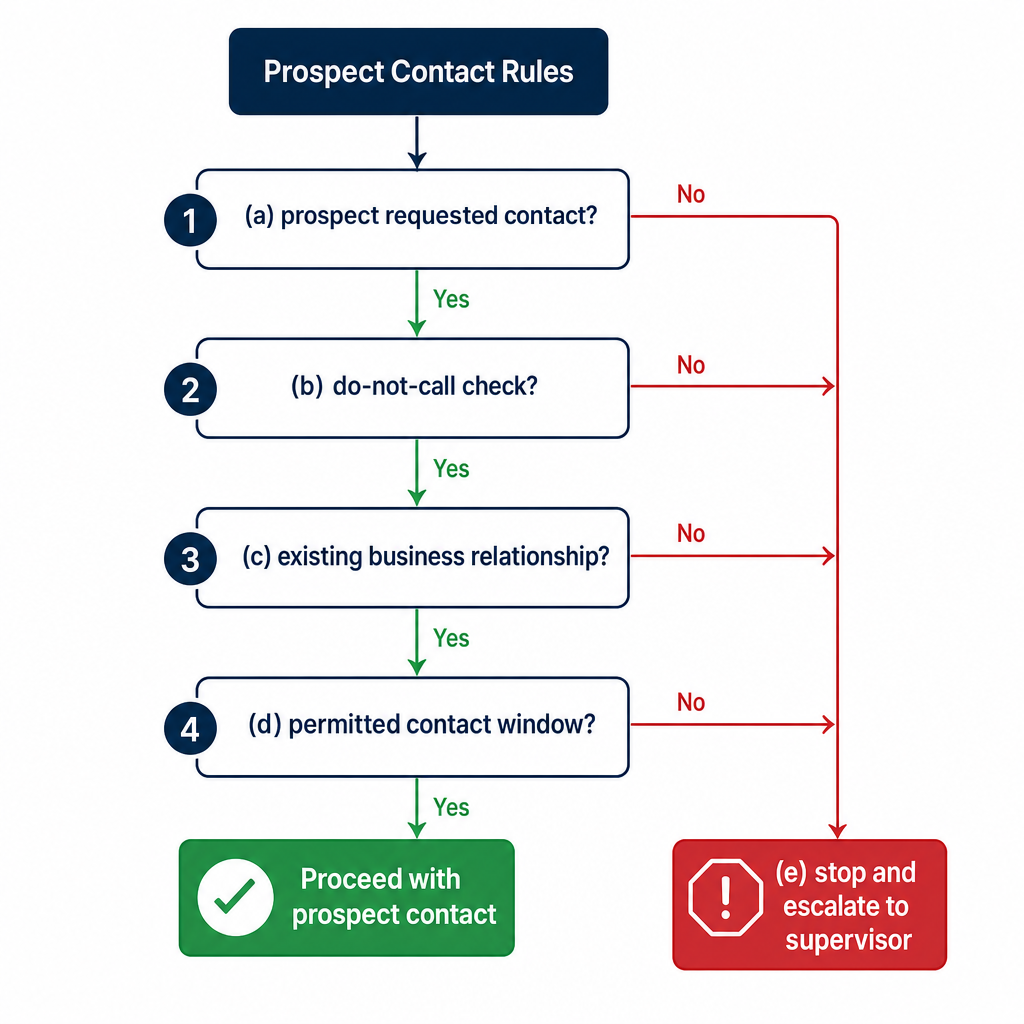
Decision conflict: choose contact only when the method, timing, consent status, and firm procedures permit it; reject outreach that ignores do-not-call limits, uses improper pressure, or treats a referral as blanket permission. A representative may seek business, but prospect contact is not unlimited. The exam often asks whether the representative should call, stop calling, check firm records, or obtain consent.
WHY THIS IS TESTED: Candidates often focus on the content of the pitch and miss the contact rule. A perfectly balanced product description can still be improper if the prospect should not have been contacted in that manner.
Exam takeaway: Before discussing products, screen whether the representative may contact the prospect through that channel at all.
B Worked example
An analyst at a hedge fund is asked by their PM to compare broker-dealer outreach practices after a market selloff. A representative has a list of referrals from a client and wants to call each prospect repeatedly over the weekend to discuss defensive strategies. The representative has not checked firm do-not-call records or whether the referrals consented to be contacted. The distracting clue is that the existing client enthusiastically recommended the representative. The tempting-but-wrong clue is that the market selloff makes the call feel urgent.
Reasoning chain: The task is to determine the compliant next step before contact. The key facts are unsolicited outreach, referral status, repeated calls, and no do-not-call or consent check. The rule is that prospect contact must comply with telemarketing and solicitation restrictions and firm procedures. A referral is not automatically permission to ignore contact restrictions. The most appropriate next step is to check applicable do-not-call and firm contact procedures before calling, and to avoid repeated pressure tactics.
C Checkpoint MCQ
A representative receives names from a satisfied customer and plans to call every referral that evening with a script about market opportunities. What should the representative do first?
- Call immediately because the names came from an existing customer.
- Check firm procedures and applicable contact restrictions, including do-not-call status, before calling.
- Call only those prospects who live in the same state as the representative.
- Send the script through a personal messaging app to avoid telemarketing restrictions.
Answer: B. A is tempting because referrals are common prospecting tools, but referral status alone is not consent. B is correct because the contact method must be screened before outreach. C is incomplete and distracts with geography. D is wrong because using a personal app can create supervision and recordkeeping problems and does not avoid solicitation rules.
1.1.1.6 4. Electronic and social media prospecting: channel approval and supervision
A Explanation
Decision conflict: choose firm-approved, retained, supervised channels; reject unapproved personal accounts, disappearing messages, unsupervised endorsements, or posts that function as public retail communications without review. Electronic communication is not a loophole. The same content standards apply, and the channel itself creates additional supervision and record-retention concerns.
WHY THIS IS TESTED: Exam stems increasingly use social media, texting, video platforms, and direct messaging because candidates may treat them as informal. The correct answer usually turns on whether the communication is business-related and whether the firm can supervise it.
Exam takeaway: In electronic outreach, both the channel and the content must pass before the communication is allowed.
flowchart TD
A[Business-related electronic message] --> B{Firm-approved channel?}
B -->|No| C[Do not send; use approved retained channel]
B -->|Yes| D{Content fair and balanced?}
D -->|No| E[Revise or withdraw before use]
D -->|Yes| F{Required review completed?}
F -->|No| G[Obtain approval under firm procedures]
F -->|Yes| H[Proceed and retain records]
B Worked example
An analyst at an RIA is asked by a compliance officer to evaluate a representative's social media plan. The representative wants to post from a personal account: "DM me to learn which bonds I am buying before rates fall." The firm permits certain preapproved LinkedIn posts but does not permit business messaging through personal disappearing-message apps. The distracting clue is that the post does not name a specific bond. The tempting-but-wrong clue is that the representative believes direct messages are private and therefore less regulated.
Reasoning chain: The task is to evaluate both channel and content. The key facts are the personal account, direct-message solicitation, unapproved messaging path, and predictive tone about rates. The rule is that business communications must use approved, supervised, retainable channels and still meet content standards. The absence of a specific security name does not cure an unapproved channel or potentially misleading teaser. The most appropriate next step is not to post and instead follow firm-approved communication procedures.
C Checkpoint MCQ
A representative uses a personal social media account to invite followers to message privately about "exclusive market ideas". The firm has not approved the account for business use. What is the most appropriate response?
- Allow it because no account has been opened yet.
- Allow it if the representative avoids naming specific securities.
- Prohibit the use of the unapproved personal channel for business communications and require firm-approved procedures.
- Allow it if the representative deletes the post after 24 hours.
Answer: C. A is tempting because the followers are only prospects, but prospecting is still business communication. B is tempting because naming securities can increase risk, but channel approval is an independent issue. C is correct because business communications must occur through approved and supervised channels. D is wrong because deletion can worsen recordkeeping concerns and does not cure the violation.
- Fill in the blank: Electronic business communication must be approved, supervised, and retainable.
- True or false: A private direct message about securities business can still be regulated communication. True.
- One-liner: What is the first problem with an unapproved personal social media account used for business? The firm cannot properly supervise and retain the communication.
Exam Traps & Differentiators
The most common wrong answer in this topic is to approve the outreach because the representative has a legitimate business purpose. Legitimate business purpose is not enough. The communication must be fair, balanced, supervised, and made through a permitted method.
Exam takeaway: Match the single disqualifying clue in the stem to the correct compliance response.
| Stem clue | Looks similar to | But is actually | Best exam response |
|---|---|---|---|
| "Safe", "guaranteed", "risk-free", or "avoid losses" | Confident product education | Misleading or promissory communication | Revise, balance, disclose risk, and obtain required approval |
| Only best performance period shown | Accurate historical fact | Cherry-picked performance presentation | Add balanced context and required disclosures or do not use |
| Referral list used for immediate calls | Warm lead prospecting | Potential solicitation restriction issue | Check consent, do-not-call, timing, and firm procedures |
| Personal texting or social media account | Efficient communication | Unapproved and possibly unretained business channel | Use firm-approved supervised channel |
| Educational seminar with product teaser | General investor education | Retail communication if it promotes products or services | Ensure fair, balanced content and required review |
1.1.1.7 If the stem says, think
- "Guaranteed income" or "no downside" - think misleading guarantee unless a very specific permitted guarantee is clearly supported.
- "Only the best returns" - think cherry-picked performance and missing context.
- "Referral gave me names" - think contact restrictions still apply.
- "Personal account", "DM", or "disappearing message" - think supervision and record retention problem.
- "We can explain risks later" - think omission in the initial communication.
- "Competitor's product is inferior" - think unsupported comparison or misleading claim unless fair and substantiated.
Algorithm / Approach
Use this mini decision flow whenever a Series 7 stem asks whether a representative may contact a prospect, distribute a message, or use a communication channel. See Fig 3 for the electronic version of the same logic.
Self-check quiz
1.1.1.8 Question 1
A representative wants to send prospects a message saying, "Our strategy helps investors avoid losses in volatile markets." The strategy includes securities subject to market risk. What is the best response?
- Send it because volatility makes the message timely.
- Send it only to prospects with high net worth.
- Revise it because it implies loss avoidance without balanced risk disclosure.
- Send it if the representative has used the strategy personally.
1.1.1.9 Question 2
A customer gives a representative five names of friends who may be interested in investing. The representative has not checked contact restrictions. What should the representative do before calling?
- Call immediately because the customer made the referral.
- Check applicable do-not-call and firm solicitation procedures.
- Call only if the market is open.
- Ask the customer to guarantee that the friends want to be called.
1.1.1.10 Question 3
A representative uses an unapproved personal messaging app to answer prospect questions about securities services. Which issue is most directly implicated?
- The prospect has not yet opened an account.
- The representative may be using an unsupervised and unretained business communication channel.
- The representative is not allowed to answer any product questions.
- The message is automatically institutional communication.
1.1.1.11 Question 4
A fund advertisement shows only the fund's best quarter and says, "Results show why this fund is built for uncertain times." What is the strongest concern?
- The advertisement may be misleading because it cherry-picks favorable performance.
- The advertisement is automatically acceptable if the return number is accurate.
- The advertisement is acceptable if sent to existing customers only.
- The advertisement is unacceptable only if the fund lost money in the current quarter.
Answer key & explanations
1.1.1.12 Question 1 answer: C
A: Tempting because market volatility creates demand, but timeliness does not permit misleading language. B: Tempting because high-net-worth prospects may be more sophisticated, but sophistication does not cure a misleading claim. C: Correct because "avoid losses" implies a guarantee or certainty inconsistent with market risk. D: Wrong because personal experience does not substantiate a broad claim to prospects.
1.1.1.13 Question 2 answer: B
A: Tempting because referrals are warm leads, but referral status alone is not permission to ignore contact restrictions. B: Correct because the representative must follow solicitation and firm procedures before calling. C: Wrong because market hours do not determine telemarketing compliance. D: Wrong because the customer cannot guarantee compliance for the prospects.
1.1.1.14 Question 3 answer: B
A: Tempting because the contact is only a prospect, but business communication rules still apply. B: Correct because unapproved personal apps create supervision and record-retention concerns. C: Wrong because representatives may provide product information when done compliantly. D: Wrong because a private prospect message is not automatically institutional communication.
1.1.1.15 Question 4 answer: A
A: Correct because a single favorable period can mislead without balanced performance context. B: Tempting because the number may be factual, but factual content can still be misleading. C: Wrong because existing customers still receive protected communications. D: Wrong because the problem is selective presentation, not only current-quarter losses.
Rapid review / cheat-sheet
- Prospecting duties begin at first contact, before account opening.
- Do not approve language that implies guaranteed results, safety, or loss avoidance for risky securities.
- A true statement can be misleading if risk, fee, liquidity, limitation, or performance context is omitted.
- Referrals are not automatic permission to call; check do-not-call, consent, timing, and firm procedures.
- Electronic business communications must use firm-approved, supervised, and retainable channels.
- Personal social media and private messages are not compliance loopholes.
- Educational seminars can still involve retail communications if they promote products or services.
- When the stem includes uncertainty about approval, the best answer is usually to obtain approval before distribution.
- When the stem includes a misleading claim, the best answer is to revise or withdraw, not to send with confidence.
- Exam shortcut: contact gate plus channel gate plus content gate; all must pass.